Triton Industries
Livestock Barns

Livestock Barns Designed Around the Animals

A livestock barn lives or dies on ventilation, drainage, and traffic flow. A Triton barn is engineered with all three in mind — open ridge vents, sized soffit intakes, sloped concrete or compacted earth floors, and aisle widths that fit your loader. Stall, gate, and feeder layouts are designed around your specific operation: cow-calf, finishing, dairy, hogs, sheep, or small ruminants.

Call 888-800-7686

Designed for animal welfare and operator efficiency

We design every livestock barn around two questions: what's the daily traffic pattern, and how do we move the most air without creating drafts? Get those right and the rest of the barn follows.

  • Open ridge ventstale air rises out, fresh air comes in at the eaves
  • Configurable stalls and gatespanel manufacturers we partner with for drop-in installs
  • Aisle widths 10' – 14'fit a skid steer, tractor, or hay wagon
  • Run-in alcovesshelter for free-stall and pasture-attached barns
Materials that survive a livestock barn

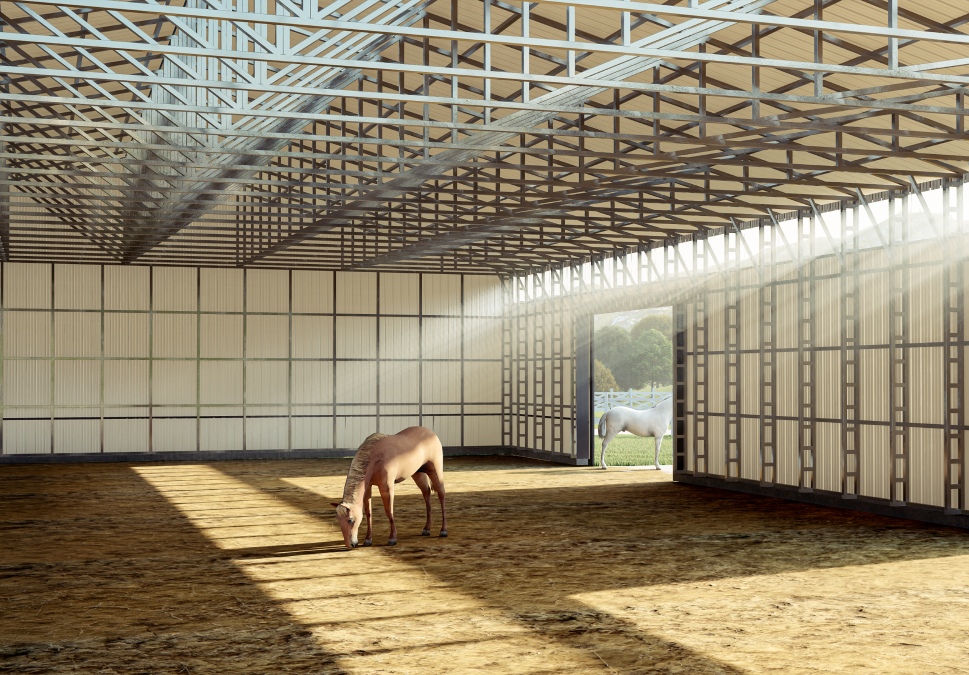
Manure ammonia, salt-block dust, and constant moisture eat painted-only steel from the inside. Our galvanized framing and Galvalume® panels resist that environment far better than budget-grade barn kits.

We also recommend a 4' – 8' kickwall of treated lumber or steel liner panel along stall walls so day-in, day-out animal contact doesn't bend the wall sheets.

Sizing your livestock barn

Square footage per animal varies by species — roughly 100 sq ft per cow-calf pair, 30 sq ft per hog, 15 sq ft per sheep — but feed and water access, calving space, and equipment access often drive the build bigger than the per-animal number suggests.

FAQs

Common Questions About Livestock Barns

Can the barn be split into pens with movable partitions?

Yes — most clients use galvanized portable panels from companies like W-W or Powder River. The Triton shell gives you a clean, posted-clear interior to lay them out however you need.

Do you build calving barns?

Yes — calving barns are typically smaller, with insulated walls and a dedicated heated jug area. We can design that as a stand-alone or integrated into a larger barn.

What's the right roof pitch for snow regions?

We typically spec 4:12 to 6:12 in heavy snow regions so snow sheds rather than accumulates. Engineering decides the final number based on your county's load.

Can I have water lines run inside the barn?

Yes — pre-frame the necessary penetrations at design time and your plumber can run lines and frost-proof hydrants without cutting steel later.

Does this work for a small hobby herd or only commercial?

Both. We've built barns for 5-head hobby operations and for 500-head finishers using the same engineering approach.

Ready to build?

Let's bring your livestock barns to life.

Call 888-800-7686
Call us888-800-7686